FREE IRISH SHIPPING ON ORDERS OVER €100




Header
Retinoids are the masters of skin resurfacing, radiance and renewal, and with the launch of the latest Skin Rocks Retinoid 3, it’s a topic that attracts a multitude of questions. Here, our Founder, Caroline Hirons, answers your most common retinoid questions.
What is a Retinoid?
Retinoid is the name given to a group of chemicals derived from (or chemically-related to) vitamin A, allowing them to work on the same biochemical pathway. For example, Retinol is a type of Retinoid. All retinoids work on the same pathway, in order to have an effect, e.g. through binding retinoid receptors.
Is Retinoid the same thing as vitamin A?
Retinoids/vitamin A are two terms that are often used interchangeably, but are technically different. Retinoids are the umbrella category of skincare ingredients that increase skin cell turnover through their activity on RARs (Retinoic Acid Receptors). As mentioned, they are all chemically related to, or derived from, vitamin A. Vitamin A is retinoic acid (also known as tretinoin), which is the active form that actually works on the skin.
Some retinoids eventually convert to retinoic acid once on the skin (these are known as first-generation retinoids or vitamin A derivatives), and others convert to another active form (these are still retinoids, but not vitamin A derivatives). All retinoids work by binding retinoid receptors.
What are Retinoids good for?
Retinoids are fantastic for multiple skin concerns and are the ‘gold standard’ in anti-ageing skincare. They help to target numerous concerns including fine lines, wrinkles, breakouts, congestion, skin texture and dullness. All Retinoids work to increase skin cell turnover, which is what helps improve signs of ageing and promote a smooth, glowing, even skin tone.
What is the strongest form of Vitamin A?
The strongest form of vitamin A is pure retinoic acid - prescribed as Tretinoin.
What different types of Retinoids are there and what are the main differences between them?
In simple terms retinoids can be grouped into a few broad types— these are the most common:
- Retinol esters (like retinyl palmitate): the gentlest form, but also the weakest and take the longest to work.
- Retinol: stronger than retinyl esters and common in over-the-counter products.
- Retinal (retinaldehyde): stronger and faster than retinol.
- Prescription retinoic acids (like tretinoin, adapalene, and tazarotene): the strongest but also the most irritating.
- New/modern Retinoids (e.g. HPR and Adapinoid): new synthetic ingredients developed to target the same pathway, while minimising negative effects such as irritation.
So while there are many names, they mostly differ by strength, speed of results, and irritation risk, with gentler forms needing more steps to become active in the skin.
It’s important to note that efficacy doesn't correlate with irritation risk, you can absolutely have outstanding results without irritation.
How does R3 compare to Tretinoin? If I already use Tret, do I need this?
Tretinoin and Retinoid 3 should not be directly compared as they serve different functions and are different products. Tretinoin is a licensed prescription-only drug and has the potential for higher levels of irritation, flaking and sensitivity. Tretinoin cannot be used by everyone, and drugs should not be directly compared to skincare formulations.
Retinoid 3 is a high strength retinoid that contains advanced ingredients designed to deliver results whilst minimising irritation. If you already use/tolerate tretinoin and are happy with the texture and results, you do not need to switch.
What is the difference between Retinol and Retinal?
Retinol and retinal are examples of different Retinoids. Both are converted to retinoic acid on the skin, but they differ in the number of conversion steps required. Retinol requires two conversion steps, whereas retinal requires only one. This means that retinal works more quickly, and more effectively.
Do the Skin Rocks Retinoids contain Retinol?
No – none of the Skin Rocks Retinoids contain retinol. These products contain other retinoids:
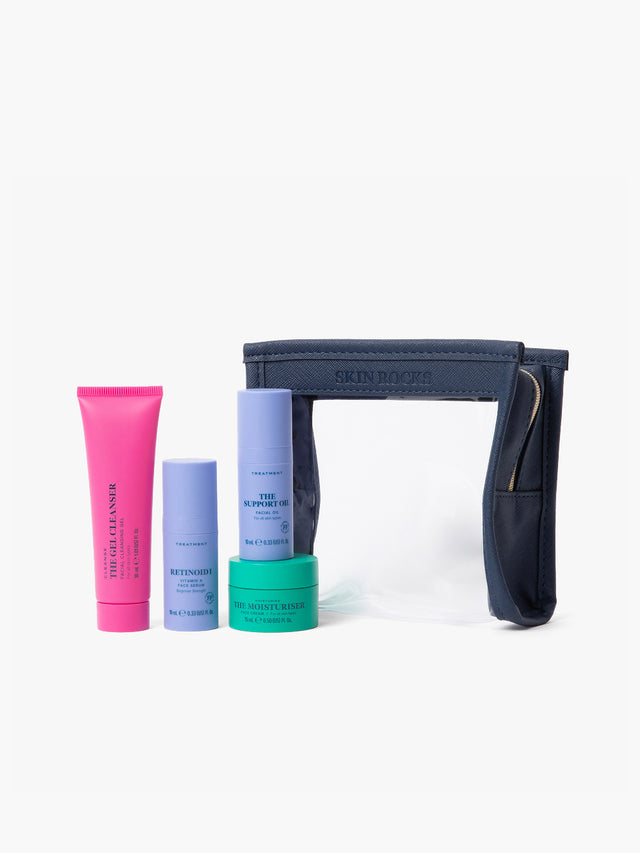
• Skin Rocks Retinoid 1 contains hydroxypinacolone retinoate (HPR).
• Skin Rocks Retinoid 2 contains HPR & retinal.
• Skin Rocks Retinoid 3 contains retinal & Adapinoid®
These have been chosen to provide optimum benefits, whilst ensuring maximum skin compatibility and formulation stability.
What is Adapinoid®?
Adapinoid® is a retinoid used in cosmetic skincare products. It is a precursor to adapalene – the prescription-only retinoid used in acne treatments, e.g., Differin – meaning that Adapinoid® transforms to adapalene once on the skin. Adapinoid® is part of the retinoid family and works in a similar way to other retinoids in that it binds retinoid receptors: increasing skin cell turnover and targeting fine lines, wrinkles, hyperpigmentation, breakouts and dullness.
Are the Skin Rocks Retinoids safe to use during pregnancy / breast feeding?
There is much debate about this, but our position is that topically applied retinoids/facial cosmetic products are safe to use during pregnancy / while breastfeeding. All Skin Rocks products are developed to fully comply with both the UK and EU Cosmetic Regulations and undergo a strict independent safety assessment before they can be sold to consumers.
Compared to prescription-strength vitamin A products/medications (often administered orally), the risk associated with topical cosmetics, including retinoids, is assumed to be minimal. To that point, there is currently, nor has there ever been, any regulatory requirement in the UK, EU or USA to label cosmetics containing retinoids as 'not suitable when pregnant/breastfeeding’.
However, if you are worried about using vitamin A/retinoids, please wait until after pregnancy. While the industry is confident that topical cosmetic retinoids are safe to use while pregnant, the general medical consensus is, if in doubt, avoid.
What % of Retinoid is in the Skin Rocks Retinoid system?
Skin Rocks Retinoid 1 contains 0.2% hydroxypinacolone retinoate.
Skin Rocks Retinoid 2 contains 0.5% hydroxypinacolone retinoate & 0.05% retinal.
Skin Rocks Retinoid 3 contains 0.21% retinal & 0.5% Adapinoid®.
Which Skin Rocks Retinoid is stronger?
The Skin Rocks Retinoids have been developed as a system - you choose the most appropriate strength depending on your previous exposure to vitamin A products, skin concern and skin goal:
• Retinoid 1 is formulated for beginners, or those with concerns around sensitivity: those who have not used Retinoids previously / have used low strength retinoids irregularly in the past.
• Retinoid 2 is formulated for intermediate users, including those who have used low- or mid-strength retinoids without sensitivity and want to level up, and those who have previously used high-strength retinoids and want to maintain results. People with advanced concerns may also start with Retinoid 2 for faster results, provided they are not sensitive and have completed a patch test.
• Retinoid 3 is formulated for advanced users, including those who regularly use high-strength retinoids without sensitivity and wish to maintain results, and those using mid-strength retinoids without sensitivity who want to level up their results.
Retinoid 1 is suitable for those with sensitive skin, Retinoid 2 & 3 are not.
Retinoid 3 is not recommended for those who are starting out with Retinoids.
You should not use a Retinoid if you have experienced previous vitamin A irritation. You should always patch test before using a new product.
Are the Skin Rocks Retinoids suitable for rosacea prone skin?
For sensitive skins, I would recommend you use Retinoid 1, as this is a gentler formula. However, do not apply the product directly to areas of inflammation or increased sensitivity. It is recommended that you carry out a Patch Test, prior to introducing any new actives / products.
Do not go against the recommendations of a medical professional specific to you and your skin condition.
Can I use the Skin Rocks Retinoids with other active ingredients? (e.g. vit C, azelaic acid, AHA, other retinoids)
Retinoids can be used with other active ingredients. However, we recommend you avoid using too many exfoliating products simultaneously / at the same time. For example, use retinoids & AHA on alternative days, or use Vit-C in the AM and Retinoids in the PM. This is particularly important if you are new to Retinoids - once your skin is tolerating well, you can look to reintroduce other actives more frequently.
Should I switch from Tret/Roaccutane to a cosmetic Retinoid?
There is no reason to use a topical retinoid when using a prescription strength Vitamin A. It is unlikely that introducing a topical cosmetic retinoid will provide any additional benefits. If you have completed your course of prescription retinoids, you may want to introduce Skin Rocks Retinoid to help maintain your results.
How do I know when to move to a higher strength Retinoid?
You should wait at least 4 weeks for your skin to acclimatise to any product. We recommend using your chosen Skin Rocks retinoid for at least 12 weeks before moving onto to the next strength, and only then if you have not experienced any issues.
Can I use Skin Rocks Retinoids every day?
No. You will not gain any benefits/amplify results by using daily, and will increase your risk of barrier damage/irritation. Introduce gradually and build up to 3-4 times a week. If you are not seeing the results you want with this schedule and are not sensitised, then you could move up to the next strength.
How do I introduce Skin Rocks Skincare products into my routine?
As with all Retinoids / Vitamin A, this will depend on your skin sensitivity.
• For Retinoid 1, we would recommend to intially use twice a week, build up to 3-4 times a week depending on your skin's need.
• For Retinoid 2 / Retinoid 3, we would recommend using twice weekly until you are aclimatised. You can then increase your use up to 3 times a week if desired.
Where do the Skin Rocks Retinoids fit within my existing skin care routine?
The Skin Rocks Retinoids should be used in the PM, after cleansing. Frequency of use depends on your skin's sensitivity / tolerance (see above answer). If you are currently using an Acid product (e.g. AHA, BHA) we would recommend you use this and the retinoid on alternative days.
When will I notice results after using a Skin Rocks Retinoid?
Your skin has a natural 4 week cycle and therefore 4 weeks is the mininum amount of time that should be used to measure any perceived skin changes. Depending on your frequency of use per week, there may be some instantaneous differences but typically it takes around 4-6 weeks for a Retinoid product to start having a noticeable effect. For example, during each clinical study, all Skin Rocks Retinoids showed significant improvements after 4 weeks of use.
With long term use, results will become more apparent and maintained.
Is it normal to breakout/purge when starting to use Retinoids?
Your skin should not ‘purge’ when using over-the-counter products. If a retinoid serum is too strong, it can sometimes cause purging; the best thing to do in this scenario is downscale to a milder formula until your skin adjusts, and then work your way up.
At what age should I introduce a Retinoid into my routine?
There is no specific age at which you should introduce a retinoid into your routine, as this will depend largely on your skin concerns. As a general rule, most people will not need to start using a retinoid until they are 25-30.
How can I layer/use my Retinoid with other hydrating products (e.g. toners and serums)?
Hydrating toners should be applied before retinoids. If your skin is sensitive, please ensure the product is fully absorbed before applying your retinoid. Hydrating serums should be applied after your retinoid.
Should I apply my Retinoid to damp or dry skin?
Always start on dry skin. Damp skin will accelerate absorption and increase the potential for sensitivity. If you consistently tolerate it well on dry skin you can then apply to damp if you wish.
How can I avoid my skin feeling dry after using a Retinoid?
Opt for a formula with skin-conditioning and moisturising ingredients, such as the Skin Rocks Retinoids. You can also follow up with a barrier oil and a rich moisturiser to offset any potential dryness.
Is R3 stronger than Medik8’s Crystal Retinal 24?
Skin Rocks formulas are unique to us and are specifically developed to have a significant point of difference to other products in the market. We have the utmost respect for other brands and will always create products with distinctive formulation and performance characteristics that defy direct comparison.
Retinoid 3 has a different chemical composition to CR24 and while both formulas contain Retinal, Retinoid 3 also contains a novel third-generation retinoid Adapinoid® plus bakuchiyl salicylate salicylate to boost retinal efficacy —both highly effective retinoids that target the Vitamin A pathway differently. You would not lose potency by using Retinoid 3 after using CR24.
What Medik8 Crystal Retinal is Skin Rocks Retinoid 3 equivalent to?
We avoid like-for-like comparison because they are not like-for-like products. Retinoid 3 contains 0.21% Retinal plus 0.5% Adapinoid — both working in different ways and targeting selective receptors. Retinoid 3 is an advanced high-strength serum for experienced users, but we consider not just strength percentages but skin comfort, product wearability, and sophistication of texture/application. Where higher percentages do not increase performance or results, we see no value in going beyond what we consider to be the optimal combination of performance and comfort.
Is Retinoid 3 better than Crystal Retinal?
The formulations and chemical compositions are different, and the specific ingredients work differently. We have the utmost respect for other brands and Medik8 is excellent, but we will always create products with unique formulation and performance characteristics that defy direct industry comparison.
Will Ret 3 stain my white bedsheets?
No, not if you allow it to fully absorb and avoid applying it just before you go to bed. Follow the recommended ‘use this much’ on the cap and apply the product with enough time for it to sufficiently absorb before bed — ideally earlier in the evening — and this should alleviate any product transfer. Any staining that may occur should correct itself after being washed.
Can Skin Rocks Retinoids be used on the eyes and lips?
No. They have been developed to be applied to the face, and are not intended to be applied directly to the lips or eyelids. These areas consist of exposed mucous membranes which can be more susceptible to irritation and sensitivity, particularly when exposed to high-strength actives.
Can I jump from 1-3 if I’ve been using various rets for years?
No. You will need to finish a bottle of Retinoid 2, or equivalent from another brand, without any irritation on the skin before progressing to Retinoid 3. Retinoid 3 is over 4x stronger than Retinoid 2.
Words by Caroline Hirons, Skin Rocks Founder and Skincare Expert